Ed Tech Startup
Role: UX Strategy & Research Consultant
The Challenge
As part of their white-label offering, this startup’s platform suggests a recommended approach to organizing the learning opportunities delivered by their partners. Currently, the approach most partners take is as shown below on Adidas’ Explore Programs landing page.
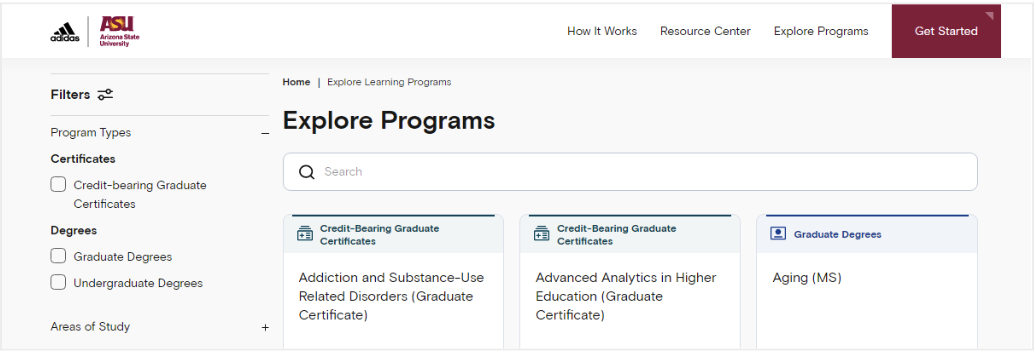
As the diversity and complexity of learning opportunities increases, layering-in brand, university, program length, credit vs. non-credit, etc., learners need a clearer framework for filtering and exploring their options. Therefore, the goal of this study is to deliver a revised approach to organizing Learning Options, or Program Types as shown above. This recommendation will be part of a larger refactor of the landing, explore programs, and program detail page being launched in 2021.
Method
This study was conducted in two parts: (1) an internal workshop made up of team members from multiple disciplines, and (2) an external research sprint informed by the internal workshop with 40 participants. Both parts focused around a hybrid card-sorting activity to understand potential evolutions of the learning type filtering.
Internal Workshop
Thirteen-members of the startup team, from a variety of disciplines, gathered in a moderated workshop setting to complete a hybrid, card-sorting exercise. In this exercise, participants were shown a set of cards with the names of the subcategories of Learning Options to organize and define into provided parent categories. The two groups produced two entirely different directions with regards to the central conceit of Learning Option subcategory filtering. This conceit revolved around the question: How to differentiate between non-credit and for-credit learning options?
Group One’s approach explored a more credit-leaning organization, introducing a new term “microcredential” as an evolution of the Degree parent category label. Microcredential was defined as “a short learning experience that is typically a skill or competence that is part of a larger skill or knowledge set.”
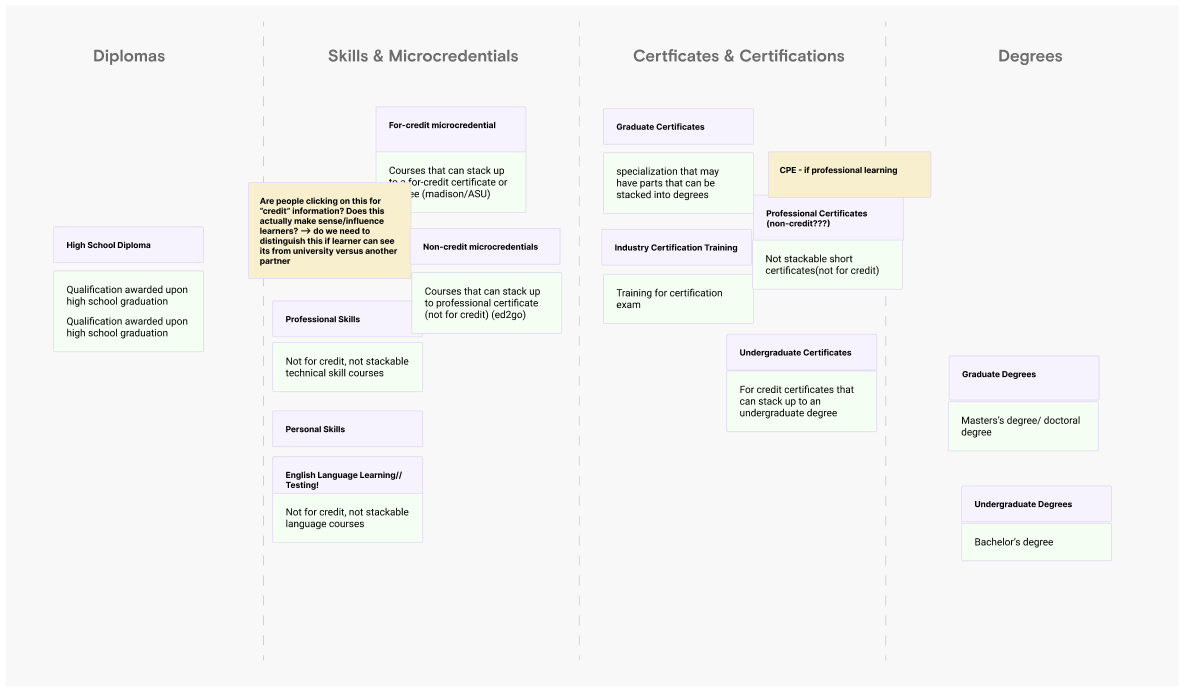
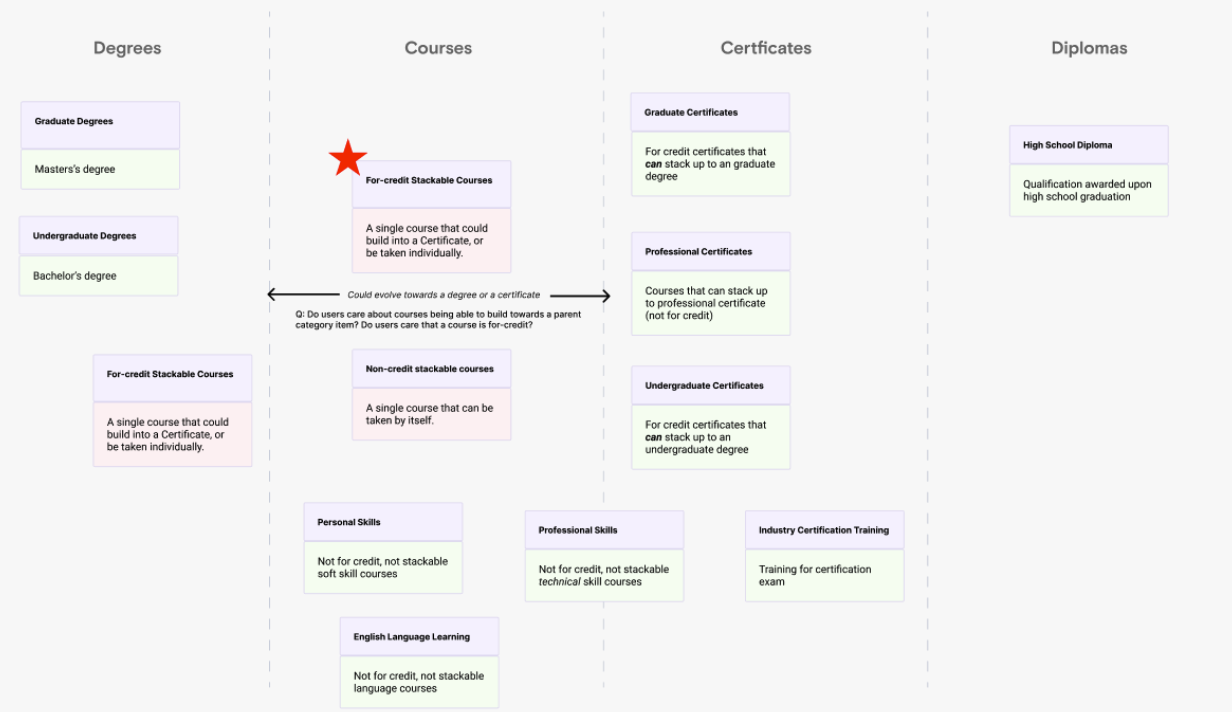
Group Two felt vehemently opposed to biasing credit-bearing learning opportunities and wanted to proselytize already understood academic nomenclature. However, this group also drew attention to the fact that individual learning opportunities often felt belonging to multiple categories; which is something that we will see mirrored in the external research results. Below is the subcategory categorization completed by Group Two.
External Research
Our external research delivered a variation of the same test to two different segments of 20 users each (total 40), using this startup’s persona demographics. Both approaches had set parent categories that users were asked to organize individual learning opportunities under via a card sorting exercise. Additional questions were asked to understand their thought process around understanding learning options and the filtering behavior.
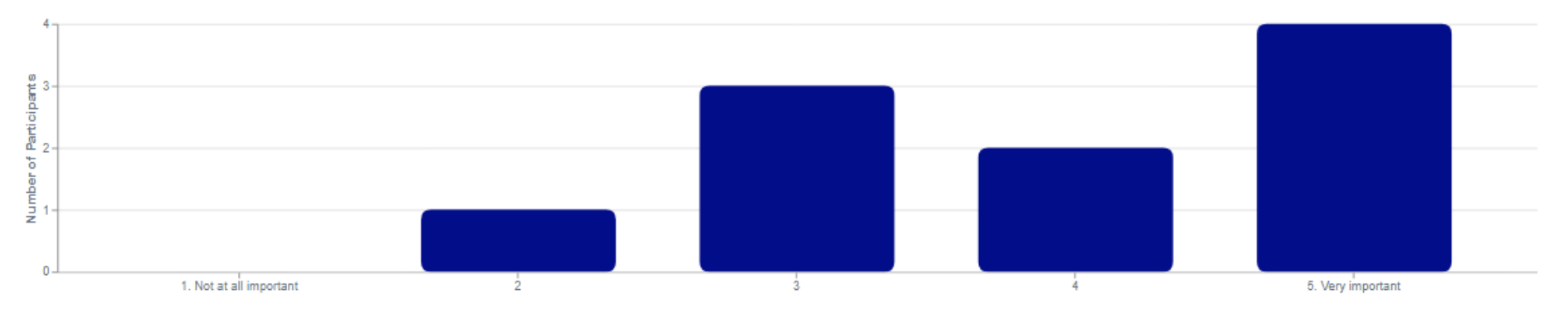
Example task
How important is it to you that college credit is awarded for an educational program that you take? Please explain your answer.
Recommendations
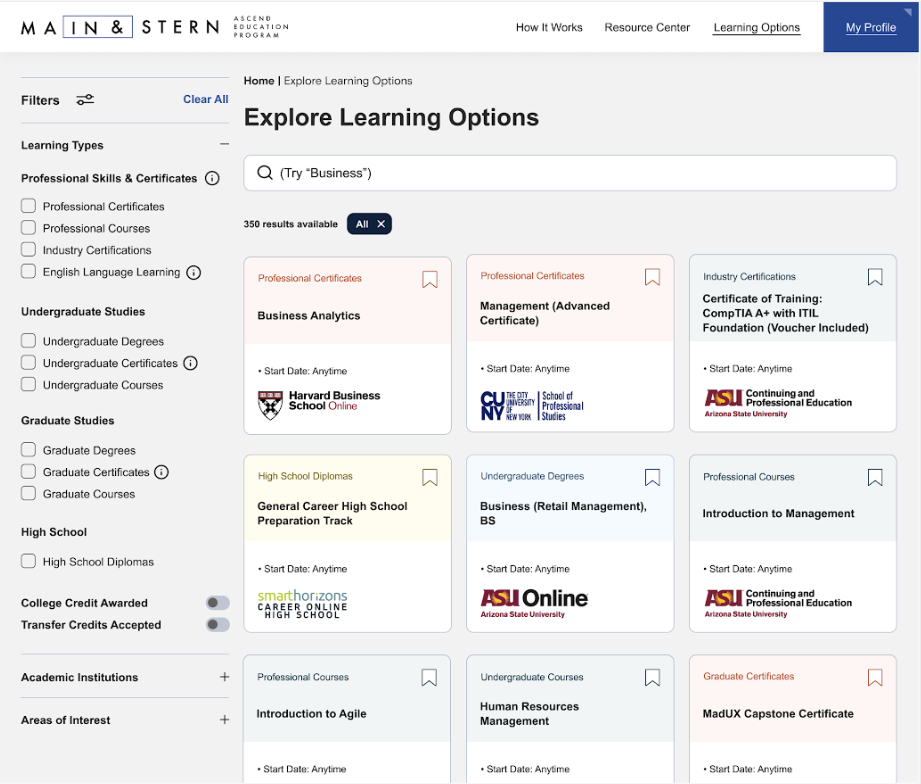
Recommendations were focused on refinements to the filtering that allowed for greater scannability and more context for users:
Grouping skill-building courses together. By grouping these subcategories together, users will be able to quickly differentiate between professional-oriented programs and certificates, versus those within the Undergraduate or Graduate parent categories.
Info tooltip. Users were hungry for more definitions to aid in their understanding of categories.
Credit Toggle. While users were divided on whether credit-bearing courses were singularly important to them, it is additional data that can support a learner’s decision-making journey.